

Happiness, By Ferry
How a Random Move to Nanaimo Rewired My Life (and Math)

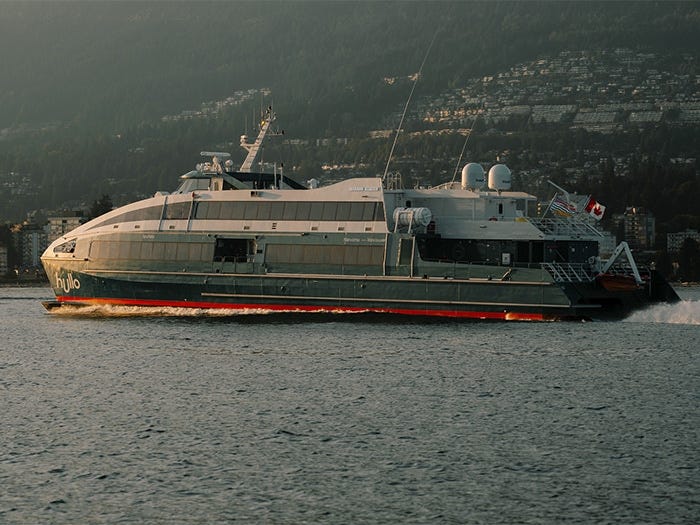
On quality, envy, and the ferry line that changed my operating system.
The move to Nanaimo was never the plan. It was the result of a series of events so random they felt like a plot twist in someone else’s life. One minute, I was on the mainland, living a life of predictable volume: noise, velocity, meetings that multiplied like a code error in a recursive loop. The next, I was packing a suitcase for a mission I hadn’t sought, accepting the role of interim CEO for Hullo, a brand-new passenger ferry service connecting Nanaimo to Vancouver.
I wasn’t escaping a problem. I was being handed one. A beautiful, complex, high-stakes problem with two new catamarans and the expectations of an entire community.
On that first crossing, not as a passenger but as the person now responsible, the pod of porpoises stitching their way through the wake felt less like a welcome party and more like a board of directors. The tide knows what it’s doing, they seemed to say. You, on the other hand, have a lot to learn.
I used to keep a simple formula on a mental whiteboard, one I’d borrowed from the bleakly brilliant mind of a British comedian:
Happiness = Quality of Life − Envy
It was clean, brutally honest, and almost worked. Then I was put in charge of the ferry, and the island didn’t just complicate the math, it made it my job description.
The Unscheduled Unraveling
If you’ve ever been handed the keys to something brand new and deeply necessary, you know the feeling: the sharp thrill of opportunity mixed with the cold weight of responsibility. My move wasn't a gentle step off a well-worn path; it was a leap into the operational hot seat. I left behind a life of abstraction for one of intense, physical consequence.
Nanaimo greeted me not as a tourist, but as the new guy in charge of the boats. The conversations were different. The stakes were higher. Here, the tide tables weren’t a quaint feature; they were a hard constraint on my P&L statement.
The island put me on immediate probation, and the lessons were delivered without subtlety. A mechanic at the marina, gesturing at a complex engine, told me, "She hates panic, and she hates assumptions." A seasoned deckhand nodded at the churning sky and said, "You can't fight the weather. You can only be ready for it."
Control what you can. Respect what you can't. Be ready.
My old happiness math began to buckle under the strain. Quality of life was no longer a personal metric; it was tied to the reliability of our service. Could we get people to their jobs, their families, their lives, on time and safely? And envy, the great subtractor, wasn't about a stranger's curated life online. It was about looking at other, more established operators in other countries and feeling the sharp, painful gap between their smooth-running systems and our early stage challenges.
The Paradox of the Well-Connected Island
There’s a romantic myth that Vancouver Island is a misty, isolated refuge. That myth dissolves the moment you become responsible for one of its primary tethers to the mainland. This place isn’t a castle with a moat; it’s a dynamic, interconnected ecosystem. And I was now in charge of a critical link in that chain.
I was living the Island Paradox from the bridge:
We sell a feeling of escape, but we function on radical connectivity.
We project a relaxed lifestyle, but we operate with military-grade discipline, because chokepoints and weather leave no room for error.
We talk about a slower pace, but building a resilient ferry service from scratch requires a speed and creative intensity that is anything but slow.
A storm wasn't just a weather report; it was a potential cancellation that would strand hundreds of people and crater our reputation. A supply chain issue wasn't an abstraction; it was a missing part that could take a vessel out of service. The island teaches you the difference between convenience and continuity. My job was to deliver continuity, because for our passengers, it was non-negotiable.
This was how Nanaimo rewired me: it replaced corporate theory with visceral accountability. I didn’t just use the infrastructure; I was the infrastructure. I knew our weak links because I was the one who had to fix them.
The Cadence of Crossings
Running a ferry line reorganized my sense of time. Mainland speed is horizontal, more meetings, more initiatives. My new speed was vertical: fewer priorities, executed with deeper focus. You don’t add more sailings to the schedule until the ones you have are flawless.
I stopped thinking in commutes and started thinking in crossings. A ferry leaves at 10:40. That wasn't a suggestion for our passengers; it was a promise I had to keep. It’s astonishing how much corporate nonsense evaporates when the on-time departure of a passenger catamaran is the only metric that matters.
Weather became a collaborator, not an obstacle. I learned to assess risk differently when the whitecaps on the strait directly impacted my team’s safety and our company’s viability. The island, through the lens of the business, forces you to plan like an engineer, lead like a captain, and improvise like a neighbour.
The result? My attention became a resource I guarded fiercely. The wilder the variables, the weather, the supply chains, the public feedback, the more I protected the core of my day for what actually moved the needle: my team, our operational integrity, our passengers' trust. The more I respected the schedule, the more I understood the profound value of what we were doing. We weren't just moving people; we were giving them back time, connection, and opportunity.
Circular by Necessity, Leadership by Design
A ferry company doesn't have the luxury of pretending resources are infinite. Every litre of fuel, every spare part, every crew rotation earns its keep. You feel the distance in your fuel bill, which is another way of saying you feel the true cost of inefficiency.
This commercial reality mirrored the island’s broader ethos. A circular mindset wasn't a sustainability slogan; it was a business imperative. We had to be clever, pragmatic, and resourceful. This meant empowering our crew, building local relationships, and creating systems that were resilient by design.
I was no longer just observing a local economy; I was participating in it in a fundamental way. We were creating jobs, supporting local suppliers, and becoming part of the community's daily rhythm. I met the economy where it lives: on the docks, in the engine room, in the ticket kiosk, and in the faces of the people who depended on us.
The New Benchmark
Let’s go back to the equation. If Happiness = Quality of Life − Envy, running Hullo fundamentally changed both variables.
Quality of Life became inextricably linked to the quality of our service. It was about the pride of seeing our boats run on time, the relief in a passenger's face when they make a critical appointment, and the camaraderie of a team pulling together under pressure.
Envy was no longer a vague social media malaise. It was a sharp, productive compass. I felt a benign envy for seasoned international operators who made it look easy. I didn't resent their success; I studied it. I wanted the operational excellence they had. I wanted the deep-seated trust they had earned. That envy wasn't a corrosive force; it was a signal, pointing directly to the standards we needed to meet.
The real pivot was this: I stopped benchmarking against other people and started benchmarking against yesterday’s performance.
Did we run a safer, smoother, more reliable service today than we did yesterday? Did I lead my team better? Did I listen more closely to our passengers? Did I secure the basics: a happy crew, a sound vessel, and a promise kept to the community?
So, I rewrote the math from a leader's perspective:
Happiness ≈ (Quality of Service Delivered) − (Destructive Comparison) + (Operational Envy → Action)
It’s not a slogan. It’s an operating system for getting things done when it matters.
My New Operating System
These are the levers that got me through. The island didn’t invent them, but the pressure of the job made them non-negotiable.
The 5 AM Scan: Before the sun, before the emails. What is the single most important thing I must protect for our operation today? What is the biggest risk, and how are we mitigating it? Who on my team needs my support most?
The Crossing Mindset: My day was built around departures. Every meeting, every call was scheduled in service of the vessels leaving the dock on time. This ruthless prioritization is how a day compounds into a reliable service.
The Envy Protocol: When I saw another company doing something brilliant, I didn't just admire it. I asked: What's the smallest version of that principle we can apply right now? Replace "I wish we were like them" with "I just implemented this."
The Input Diet: I treated news and social media like the weather: check it for situational awareness, but don't let the storm of opinions knock you off course. The most important feedback came from our passengers and our crew.
The Evening Ledger: Did we keep our promise today? Where did we fall short? What did we learn that will make us better tomorrow?
The Day the Equation Vanished
There’s a bench on the Nanaimo harbour that looks out at the departing ferries. One evening, after a day that was brutally challenging but ultimately successful, I sat there and realized the math had changed again.
It had disappeared.
I wasn't comparing our relatively modest company to the giants. I was comparing us to who we were last week. I wasn't hoarding personal wins; I was reinforcing the resilience of my team. I wasn't chasing applause; I was chasing on-time performance. My day’s ledger was short and clean: we got our passengers home, we kept our crew safe, and we learned how to do it a little bit better tomorrow.
On the walk home, the tide was out, and the harbour lights came on early. I took the long way back, just because I could. Because the last Hullo ferry had long since departed, and for one more day, we had made all the crossings that mattered.
The island didn't just make me happy. The ferry line made me accountable. The challenge made me a better leader. It forced me to choose a game where success is shared, and the prize is a community well-served. It gave me a math I can do with cold hands and a warm brain.
And that was worth the crossing.
Hugs, Ryan. Best wishes for your endeavour.
Its great to have you aboard Ryan